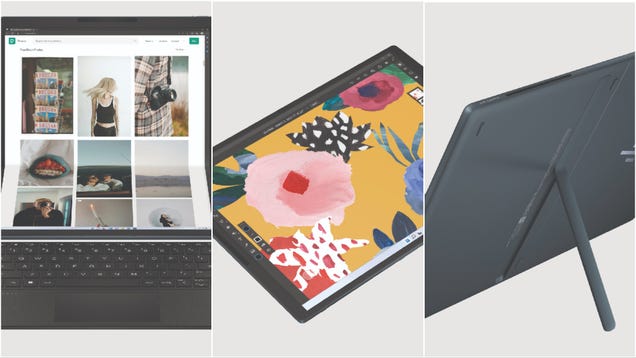
Back in 2020, Lenovo released the first laptop with a flexible display. And then last year, ASUS added its touch to the category with the Zenbook 17 Fold OLED. Now HP is giving things a go with the Spectre Fold and, after checking out one of just three pre-production samples sent out to the media, it feels like this is easily the best use of the technology yet.
The most striking thing about the Spectre Fold is its design. HP has managed to slim down its bezels and remove nearly all of the chunkiness we saw on the foldable ZenBook. With its 17-inch 2560 x 1920 OLED display opened all the way, the whole thing looks just like any other premium tablet (except for it being really big), which is a pleasant surprise. At 8.5mm thick, it’s deliciously thin and by opting for a lightweight magnesium body, the Spectre Fold tips the scales at just 2.86 pounds (1.3 kg) – a full pound less than ASUS’ creation from 2022.
The Spectre Fold’s display looks great too. The panel is made by LG and basically crease-free (unless you look real hard from an angle), while boasting a listed brightness of up to 500 nits, along with VESA True Black HDR 500 certification. And for all your videoconference needs, HP crammed in a sharp 5-MP IR webcam that supports some clever security features like privacy alerts and automatic walkaway detection.
There’s also a slick kickstand that sits flush against the bottom of the system when not in use. In fact, it looks more like a simple design accent than something functional. Pretty much everywhere you look, the Spectre Fold feels just as sleek and polished as any high-end laptop. Now, that might not sound like a major accomplishment, but given the awkwardness that we’ve seen on previous competitors, that’s no mean feat. I also appreciate how HP included handy features like a switch for a physical webcam shutter and two Thunderbolt 4 ports. And then there are all of the Spectre Fold’s bundled accessories, which include a magnetic Bluetooth keyboard, a stylus (with a spare nib) and even a USB-C docking hub.
Photo by Sam Rutherford/Engadget
This brings me to the next best thing about the Spectre Fold, which is how well it works with all of its accessories right out of the box – I didn’t need to mess around with Bluetooth settings or anything. I just fired up the laptop, flipped the toggle on the side of the keyboard and they instantly connected. That is a big improvement compared to what I experienced on the Zenbook 17 Fold and its flaky Bluetooth that forced me to manually repair its keyboard on a semi-regular basis. HP also designed the system to have a 5mm fold radius, which allows the keyboard to nest neatly inside the laptop during travel.
But the perhaps coolest thing about the Spectre Fold (aside from its display, of course) is what you don’t see: a series of charging coils that are hidden inside one edge of the system. This allows both the keyboard and the stylus (which also attaches magnetically) to trickle charge from the laptop’s battery while not in use, so you never have to worry about topping them up yourself. Though, if the keyboard does for some reason run out of juice, HP does include a special USB power dongle that you can whip out in a pinch.
Photo by Sam Rutherford/Engadget
Of course though, the display is the coolest part. The bendability makes the Spectre Fold what HP says is its first 3-in-1 as it can transform into a tablet, a portable all-in-one desktop and a few different laptop setups. Tablet mode is pretty straightforward, while AIO mode allows you to prop up the display so you can get the most out of that big 17-inch display (I would have loved to have this while traveling recently).
As a laptop, you can choose a somewhat traditional clamshell configuration where you put the keyboard on the bottom half of the display while the top half provides what is essentially a 12.5-inch screen–which is great for tight spaces. Alternatively, you can slide the keyboard towards you to create what HP calls expanded mode, which might be my favorite laptop position. In this setup, the touchpad section of the keyboard drops down and provides a more ergonomic wrist rest. Doing that also reveals more of the folded display (around 14 inches in total) or what HP calls “1.5 screens.” This gives you just enough room to keep things like email or chat apps down below while you have a more important project open up top.
Photo by Sam Rutherford/Engadget
Finally, there’s extended mode in which you simply place the keyboard on a table in front of the Spectre Fold, giving you full access to that 17-inch screen, but in a bent portrait orientation. Regardless of which setup you prefer, the laptop tries to give you the largest display possible based on your current environment. And thanks to even more magnets inside the system, the keyboard naturally snaps to these various positions resulting in a surprisingly seamless experience.
Granted, even this early I’ve noticed a couple tiny issues, like how the display looks dimmer when viewed from more acute angles, which is what you’ll see in some of its laptop modes. But that’s sort of par for the course even among today’s best flexible screens. Also, while its Intel Core i7-1250U, 16GB of RAM and 1TB SSD delivered relatively snappy performance thus far, I’m not expecting a ton of oomph for stuff like editing videos or even light gaming.
Photo by Sam Rutherford/Engadget
However, the Spectre Fold’s biggest hurdle is its price: $5,000. That’s even more than the $3,500 ASUS Zenbook 17 Fold, which was already an extremely expensive machine. This is enough to put it out of reach of pretty much everyone, which is definitely a bummer. But at the same time, HP says it created this thing in large part just to show what the company can do with today’s cutting-edge tech. And when viewed more as a forward-thinking demo unit than something people are actually going to buy, I’m a bit less upset about its cost (if only just a bit). I should also point out that despite showing it off more than a year ago, Lenovo’s second flexible-screen laptop–the 17-inch ThinkPad X1 Fold–still doesn’t have a concrete release date. This just shows how difficult systems like this are to make even for companies of this size (Lenovo and HP are the two biggest PC vendors in the world).
That said, if you’re willing to throw a couple of rent payments (or more) at this thing, pre-orders for the Spectre Fold go live today from Best Buy, with official sales on HP.com and Best Buy expected to happen sometime in October.
This article originally appeared on Engadget at https://ift.tt/OeUzh5r
from Engadget is a web magazine with obsessive daily coverage of everything new in gadgets and consumer electronics https://ift.tt/OeUzh5r
via IFTTT https://ift.tt/nAJHRqc
Foldable phones promise us the 2-in-1 experience. There is Samsung’s Galaxy Z Fold 5 rolling out in the wake of Google’s first device with clapping screens, the Pixel Fold. Each vow they will be users’ phones and tablets, all inside your pocket. HP’s latest laptop takes the same sort of philosophy and expands it to a…
You might see more sponsored recommendations when you fire up your Spotify app, now that the music streaming giant has started offering artists a new paid tool they can use to promote their music. "Showcase" gives artists a way to put their music in front of more people, whether their tunes are newly released or are something from deep in their catalog. They can create multiple campaigns for different content, and they can use Spotlight to promote not just singles, but also EPs and albums.
These sponsored recommendations will appear under various headlines — succinct information about them designed to get your attention, really — provided by Spotify, depending on what the artist's team chooses. They can promote their stuff as "new music," for instance, or use the headline "on tour," if they're on the road and want to drum up more interest. In the image above, the single that's being promoted entitled White Winter Hymnal uses the headline "seasonal vibes." In addition, artists can choose the people they want to target and can go for both active listeners and previous ones.
According to Spotify, Showcase ads will be shown in 30 markets. The streaming giant also claims that people who do see them are six times more likely to stream whatever it is being promoted. If you stream music you've seen through a particular Showcase ad, you won't see it again for 28 days. Musicians are charged per click, after all, with prices starting at 40 cents. Initially, though, Spotify will only offer Showcase to artists with at least 1,000 streams over the past 28 days and whose billing country is set to the US. It will roll out the tool within the Campaigns tab for eligible artists in the US over the coming weeks, but it says it will expand access to it worldwide over time.
This article originally appeared on Engadget at https://ift.tt/irnTD4R
from Engadget is a web magazine with obsessive daily coverage of everything new in gadgets and consumer electronics https://ift.tt/irnTD4R
via IFTTT https://ift.tt/Cd36DZs
If there’s one drink you should pack with you on a future trip to space, let it be kombucha. The fizzy, fermented drink has not only taken over trendy spots in Brooklyn, but it can also be found in low Earth orbit as part of an ongoing experiment of its resilience in the harsh space environment.
I use an Android watch, but even I have to say, when it comes to user interfaces, Apple knows how to hit the mark. That’s nowhere more apparent than with the new double tap gesture on the Apple Watch Series 9 and Ultra 2, announced at its Wonderlust event, where it also debuted the iPhone 15.
Being a night owl might not be great for your blood sugar control, new research this week suggests. The study found that middle-aged women who prefer to stay up late were more likely to develop type 2 diabetes. This associated link was found even after the researchers accounted for other unhealthy behaviors more…
Farewell Lightning cable. I will miss you when I inevitably get rid of all my cables, only to forget my MacBook wireless keyboard and trackpad still need you. Yes, the iPhone is going USB-C for 2023. That’s true across the iPhone 15, iPhone 15 Plus, iPhone 15 Pro and iPhone 15 Pro Max. And AirPods Pro.
Apple hasn’t changed the screen sizes of this year’s iPhones. The base iPhone 15 and the Pro have 6.1-inch displays, while the Plus and Pro Max have 6.7-inch screens. All the 2023 family now get the dynamic island display cutout that debuted on last year’s iPhone 14 Pro, and the iPhone 15 hardware has an all-new design with rounded edges. Apple has introduced a new camera system to the iPhone 15, which includes a 48MP main camera, but the most impressive imaging upgrades are just for the Pro phones.
Touching on the most-specced out device, thePro Max differentiates itself with some heady camera upgrades I’m very excited to try. You’ll get a 5x telephoto zoom lens with a 120mm focal length equivalent — a substantial jump from 3x zoom of the iPhone 15 Pro (and last year’s models). Apparently, this was achieved withtetraprisms.
On the side of the iPhone 15 Pro, there’s a new Action button that replaces the old Mute switch. This allows users to quickly access features like the camera, flashlight, Voice Memos and more. You can also configure it to activate your own shortcuts, with a new press-and-hold gesture, featuring haptic feedback and visual cues from the Dynamic Island, to ensure you know when a command goes through.
Both Pro phones will get a newA17 Pro chip, capable of ray tracing graphics, and Apple is teasing that AAA games, like Death Stranding, Resident Evil Village and Assassin’s Creed Mirage (more on that one below), will come to the iPhone 15, running natively.
We’ve got more highlights from the event below.
— Mat Smith
You can get these reports delivered daily direct to your inbox.Subscribe right here!
Apple revealedtwo new watches this year. The Series 9 features overall performance boosts and a new processor, the S9 chip, which promises 18-hour battery life. Apple has also added a gesture to the Apple Watch Series 9 and Apple Watch Ultra 2:Double Tap. This lets you control various system functions by tapping your thumb and index finger together twice quickly. You can use Double Tap to answer or end calls, snooze alarms, play / pause music or start and stop timers.
The hardware might not be entirely game-changing, but the software is shaping up to offer a more usable interface than ever before, at least according to my time so far with the beta version. The premiumApple Watch Ultra 2 offers a brighter screen (3,000 nits!) and, according to Apple, will top out at 36 hours of battery life on one charge.
Assassin’s Creed Mirage is blessedly billed as a return to the series’ leaner early days, when Ubisoft was restricted by PlayStation 3 and Xbox 360 hardware. After a few hours of hands-on time across three sections of the new game, it feels like that’s the case. Mirage largely takes place in ninth-century Baghdad, a couple of centuries before the Holy Land setting of the original Assassin’s Creed, but around the same time as AC Valhalla (Mirage protagonist Basim made his first appearance in that game). Assassin’s Creed Mirage will arrive on PlayStation 4, PlayStation 5, Xbox One, Xbox Series X/S and PC on October 5.
The latest iPhone software update will be available next week, on Monday, September 18. The public preview for iOS 17 has been available since June and has already shown off a number of design refinements, which Apple recapped during its keynote. Those include user-definable outgoing call screens, so you can pick what people see when you call them, and an option to send incoming calls to voicemail and read a transcription of them instead. Users will also be able to send quick voice or video messages if someone doesn’t pick up their FaceTime calls. You can see our in-depthiOS 17 preview right here.
Up to three times the bandwidth of Thunderbolt 4. Support for multiple 8K displays, as well as gaming monitors running at up to 540Hz. And 240 watts of charging power. These are key features of Thunderbolt 5, Intel’s latest stab at creating the ultimate PC cable. Great, so my iPhone USB-C cable is already going to be defunct in a year or two…
This article originally appeared on Engadget at https://ift.tt/qJ62cxd
from Engadget is a web magazine with obsessive daily coverage of everything new in gadgets and consumer electronics https://ift.tt/qJ62cxd
via IFTTT https://ift.tt/FK5sviN
As Google faced off against the Department of Justice on the first day of a hotly anticipated antitrust trial, company lawyer John Schmidtlein laid out an interesting perspective. “This case is really all about Microsoft,” Schmidtlein said.
After September 29th, Netflix will no longer rent DVDs by mail and will be winding down that part of its business altogether. Most people might be surprised that the streaming giant is still even renting DVDs, but if you're one of its subscribers who'll be sad to see the service go, there's now another rent-by-mail option you can use anywhere you are in the US. Scarecrow, the largest independent video store in the US, has launched its own rent-by-mail service that will send DVDs and Blu-ray discs straight to your door.
The store first piloted the service back in 2019 before it started working on making its library available to people across the country during the pandemic. As The Seattle Times reports, it launched a campaign in 2021 to raise funds for an overhaul of its aging website, making it more searchable and giving it a more modern look. Now, Scarecrow's rent-by-mail website is live, with step-by-step instructions on how to avail of the service and a searchable library divided by genres.
To be able to rent from Scarecrow, you'll need to sign up for an account, which will have to be verified and approved by a staff member. After that, you can start adding DVDs to your cart. Titles are priced individually, but shipping will cost you $12 for up to six discs. That's discs, not titles, which means if one movie has six discs, you can't add more to the same shipment. The rental window is 14 days, including shipping, after that you can either renew by phone or pay late fees.
Scarecrow has 140,000 titles in its collection — comparably, Netflix has around 5,000 titles in its US catalog, according to CordCutting — most of which you can rent by mail. There are exceptions, however, including rare and out of print videos that require a security deposit, newly released movies and adult titles. It also doesn't mail VHS tapes and laser discs, so you'll have to go elsewhere for those formats.
This article originally appeared on Engadget at https://ift.tt/Qtsodki
from Engadget is a web magazine with obsessive daily coverage of everything new in gadgets and consumer electronics https://ift.tt/Qtsodki
via IFTTT https://ift.tt/7VkAQqN
Up to three times the bandwidth of Thunderbolt 4. Support for multiple 8K displays, as well as gaming monitors running at up to 540Hz. 240 watts of charging power. These aren't just the highlights of my PC connectivity dreams: They're key features of Thunderbolt 5, Intel's latest stab at creating the ultimate PC cable. And this time, the chip maker may actually succeed.
When Thunderbolt 4 dropped in 2020, it mostly seemed like a refined version of Thunderbolt 3. It had the same maximum bandwidth of 40 gigabits per second, but its increased efficiency allowed Intel to standardize support for multiple 4K screens, as well as double storage device speeds. At the very least, Intel required at least one Thunderbolt 4 to support USB-C charging.
Thunderbolt 5, on the other hand, is a major leap forward. It's built on the USB4 v2 spec, which offers the same speed improvements, but Intel is making key features a requirement. That includes a baseline speed of 80 Gbps and support for 120 Gbps using bandwidth boosting (USB4 requires 20 Gbps); support for dual 6K screens (Thunderbolt 4 requires dual 4K monitors); and a minimum of 140 watt charging and a more powerful 240W mode.
Since it was originally known as Light Peak, Intel's goal with Thunderbolt was to develop a single cable that could handle all of your data and power needs. This latest version should satisfy even more demanding PC users. With up to 240W of charging, for example, some gaming laptops and workstations wouldn't need a separate power port. That means fewer cables to carry, as well as the assurance that you could always borrow someone else's USB-C cable and adapter to juice up.
Intel
As Intel previously announced, Thunderbolt 5 will also support the DisplayPort 2.1 and PCI Express Gen 4 standards. The latter should be particularly helpful with external GPUs, which have been significantly bandwidth limited until now. We can also expect that additional bandwidth to support new accessories like external AI accelerator, as well as far faster external storage.
Intel says that Thunderbolt 5 accessories and PCs will be available in 2024. It'd be nice to have a clearer time frame, but Intel may be trying to avoid scaring off people from buying new systems this year.
This article originally appeared on Engadget at https://ift.tt/dc4rkQ2
from Engadget is a web magazine with obsessive daily coverage of everything new in gadgets and consumer electronics https://ift.tt/dc4rkQ2
via IFTTT https://ift.tt/D1lQ0gr
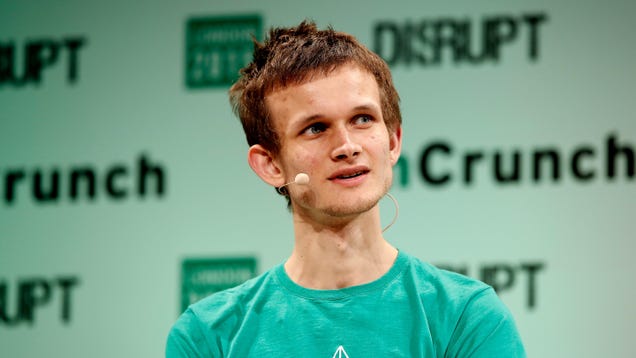
Vitalik Buterin, a computer programmer who co-founded the popular cryptocurrency Ethereum, is clearing the air after his account on Twitter (now known as X) was hacked this weekend. The hack involved a post touting a commemorative NFT that was actually a cryptocurrency wallet drainer.
Meta has rolled out software update v57 for its Quest headsets, and one of the biggest changes it brings is giving you the ability to make your avatar a better representative of your true self. When you choose a certain color for your hair and eyebrows, for instance, you'll be able to fine-tune it further through a slider that lets you adjust its depth. Yes, that means you'll now be able to more accurately pick your avatar's skin tone. You can put makeup and face paint on your avatar, in the exact colors you want, as well.
In addition, update v57 gives you the capability to unsend image messages in virtual reality and the Meta Quest mobile app. When you hover over the image in VR or click on it in the app, you'll see the option to "Unsend a message." If you choose to do so, both parties will get a notification that a message has been removed for transparency. At the moment, this particular feature is available in Australia, Canada, Iceland, New Zealand, South Korea, Switzerland, Taiwan and the US.
If the feed that greets you when log into VR looks different, that's because Meta is also replacing Quest's Explore feed with an updated one dubbed the "Horizon Feed." It still shows content relevant to your interests, though, so long as they're age-appropriate. Finally, update v57 introduces free-form locomotion, which lets you teleport throughout your Home space instead of being confined to predetermined spots. You still can't move through walls, furniture and other objects, but you can now at least explore your environment more freely.
This article originally appeared on Engadget at https://ift.tt/viKJo5O
from Engadget is a web magazine with obsessive daily coverage of everything new in gadgets and consumer electronics https://ift.tt/viKJo5O
via IFTTT https://ift.tt/fyqKe0v
A small number of Apple's iPhone 15 models manufactured in India could be available on launch day for the first time, according to a report from Bloomberg. Apple has built iPhones in India since 2017, but it has typically taken up to a year to ramp up production. This time, a small number built in India could go on sale immediately in that nation and some other regions.
It's been known for a while now that Apple contractor Foxconn would manufacture more iPhone 15 models than before at a facility in Tamil Nadu, India. It's part of Apple's plan to diversify manufacturing in the face of supply chain risks due to tensions between the US and China. The number of units available on launch day from India will reportedly depend on the availability of components manufactured elsewhere and Foxconn's ability to ramp up production.
Apple has only built a fraction of its iPhones in India, and production has typically lagged behind China by six to nine months. That changed with the iPhone 14, as Foxconn (and another manufacturer, Pegatron) were able to start manufacturing in India within the same month of the official release. Apple intends to eventually shift 25 percent of its production to the nation.
Recent conflicts between the US and China haven't impacted Apple much, likely because Foxconn and other suppliers in the nation employee millions of people. It also has followed China's laws, removing thousands of illegal apps like VPNs. However, recent actions in the country to ban iPhones and other foreign devices for government officials have left the company more vulnerable than usual. Apple also sells a large number of phones in China, accounting for about 19 percent of its total revenue.
Apple is set to release the iPhone 15 today at its Cupertino HQ, reportedly with thinner bezels, a titanium frame, USB-C charging and more. We're also likely to see updated watches and Airpods, along with its latest iOS 17, watchOS 10 and iPadOS 17 operating systems.
This article originally appeared on Engadget at https://ift.tt/iA8R6xt
from Engadget is a web magazine with obsessive daily coverage of everything new in gadgets and consumer electronics https://ift.tt/iA8R6xt
via IFTTT https://ift.tt/fyqKe0v
Lorcana has revealed its newest set: Rise of the Floodborn. It features characters from both classic and new Disney franchises, spread across 200 cards. Characters from films like The Jungle Book, Snow White and the Seven Dwarfs, The Great Mouse Detective, Pinocchio, Zootopia, and Raya and the Last Dragon will make…
Get a look at Disney’s new Goosebumps show. Chucky heads to the White House in new pictures. Plus, another teaser for The Strangers Trilogy, and what’s coming on Quantum Leap and FLCL Grunge. Spoilers, away!
Apple is hell-bent on becoming a closed ecosystem unto itself by designing the chips inside its own devices. With the upcoming iPhone 15 moving toward the A17 Bionic chip, the company’s first 3nm processor, and Apple’s desktop and laptops gunning for an M3 chip, the company headquartered at the end of 1 Infinity Loop…
What you're looking at is a concept car, but it's also so much more. This is the car that could change everything you've come to expect about acceptable range from an electric car, not to mention raise the bar for visual style and aggression along the way. This is the Mercedes-Benz Concept CLA Class.
The Concept CLA inherits a lot of learnings from the extremely slippery Vision EQXX, but it's a car that’s a lot more ready for production, and should be a lot more affordable. The current CLA is one of the most affordable Mercedes-Benz cars you can buy in the US, and with any luck this future one won’t break the bank, either.
That’s despite a range that should surpass 400 miles on a charge, plus a wholly new software architecture ready to deliver level-three advanced, hands-off driver assistance. It’s an exciting combination of form and technology, and hopefully close to something we’ll see in dealerships soon. Watch the video below for the full story.
This article originally appeared on Engadget at https://ift.tt/xHo6L7P
from Engadget is a web magazine with obsessive daily coverage of everything new in gadgets and consumer electronics https://ift.tt/xHo6L7P
via IFTTT https://ift.tt/XM5VWnN
Recording Academy CEO Harvey Mason Jr. is setting the record straight. After Variety reported earlier this week that an AI-generated track echoing the voices of Drake and The Weeknd could be considered for a Grammy Award in songwriting categories, Mason is insisting that’s not the case.
In an interview with The New York Times only last week, Mason suggested the track would be “absolutely eligible” as the lyrics a human made the lyrics. On Instagram, the Recording Academy CEO has now clarified that the song will not be eligible.
“Even though it was written by a human creator, the vocals were not legally obtained, the vocals were not cleared by the label or the artists and the song is not commercially available and because of that, it’s not eligible,” he said. Sorry robots.
– Mat Smith
You can get these reports delivered daily direct to your inbox.Subscribe right here!
Affordable Windows notebooks are great for people who only use a computer to check email, shop online or post on Facebook. They’re also good for kids who have no business putting their sticky little hands on a $2,000 gaming rig. And, depending on what you need them for, these devices can be decent daily drivers, too. Here’s what to look for in a cheap Windows laptop – and some of our recommendations.
Google desperately would love for you to remember that it will announce its own devices after Apple has its turn. Rather than just... holding its own event before Apple’s, Google has instead teased its upcoming devices with short videos. After dripfeeding details about the Pixel 8 lineup, now Google is teasing a new Pixel Watch that will feature IP68 dust and water resistance.
Apple has its fingers in many pies, and now it’s getting into the monster business with an upcoming TV show. The company has released the first trailer for Monarch: Legacy of Monsters and while the title might not make it super clear, this is a Godzilla affair. Get lost, Mothra.
You may be able to ask an Uber provider to help you mount a TV.
According to Bloomberg, Uber is exploring offering a new TaskRabbit-like service. Developer Steve Moser found code hidden in Uber’s iPhone app for an offering reportedly codenamed Chore. Based on its current iteration, Chore will let you hire “taskers” and specify in the app what you need help with, how long you think it would take and what time you want the tasker to arrive. It’s all pretty similar to TaskRabbit. Like any other unconfirmed feature still in development, Chore may not even make it to public release. If it does, it’ll be a huge new undertaking for Uber.
This article originally appeared on Engadget at https://ift.tt/7t2ynF5
from Engadget is a web magazine with obsessive daily coverage of everything new in gadgets and consumer electronics https://ift.tt/7t2ynF5
via IFTTT https://ift.tt/hws5KpL
Franchises have been the name of the game in Hollywood for years, and Warner Bros. has been franchise-heavy more than most. Between various DC movies, the different Conjuring films, and whatever else, the studio has had a big franchise push over the last decade. But for current CEO David Zaslav, the company hasn’t…
Throughout the decades, various writers have taken Wolverine for one ride after another. And if there’s one writer whose legacy looms large over the X-Men character, it’d certainly be Chris Claremont, who helped launch the character into being one of Marvel’s key characters and a larger brand unto himself.
Back in July, Disney released its remake of Haunted Mansion, which didn’t really light the world on spectral fire when it came out. Part of it was due to other big movies releasing in late July at the time and stealing whatever thunder it could’ve possibly had. (Not to mention, it was one of the first movies to hit…
There’ve been so many Batman movies over the last several decades, but Tim Burton’s titular 1989 film holds a special place in the history of superhero films. It was the first Batman movie—or well, one of them—seen by many a generation, and its impact can be felt across future live-action takes on the character, Batman…
You didn't actually believe all those founder's myths about tech billionaires like Bezos, Jobs and Musk pulling themselves up by their bootstraps from some suburban American garage, did you? In reality, our corporate kings have been running the same playbook since the 18th century when Lancashire's own Richard Arkwright wrote it. Arkwright is credited with developing a means of forming cotton fully into thread — technically he didn't actually invent or design the machine, but developed the overarching system in which it could be run at scale — and spinning that success into financial fortune. Never mind the fact that his 24-hour production lines were operated by boys as young as seven pulling 13-hour shifts.
In Blood in the Machine: The Origins of the Rebellion Against Big Tech— one of the best books I've read this year — LA Times tech reporter Brian Merchant lays bare the inhumane cost of capitalism wrought by the industrial revolution and celebrates the workers who stood against those first tides of automation: the Luddites.
The first tech titans were not building global information networks or commercial space rockets. They were making yarn and cloth.
A lot of yarn, and a lot of cloth. Like our modern-day titans, they started out as entrepreneurs. But until the nineteenth century, entrepreneurship was not a cultural phenomenon. Businessmen took risks, of course, and undertook novel efforts to increase their profits. Yet there was not a popular conception of the heroic entrepreneur, of the adventuring businessman, until long after the birth of industrial capitalism. The term itself was popularized by Jean-Baptiste Say, in his 1803 work A Treatise on Political Economy. An admirer of Adam Smith’s, Say thought that The Wealth of Nations was missing an account of the individuals who bore the risk of starting new business; he called this figure the entrepreneur, translating it from the French as “adventurer” or “undertaker.”
For a worker, aspiring to entrepreneurship was different than merely seeking upward mobility. The standard path an ambitious, skilled weaver might pursue was to graduate from apprentice to journeyman weaver, who rented a loom or worked in a shop, to owning his own loom, to becoming a master weaver and running a small shop of his own that employed other journeymen. This was customary.
In the eighteenth and nineteenth centuries, as now in the twenty-first century, entrepreneurs saw the opportunity to use technology to disrupt longstanding customs in order to increase efficiencies, output, and personal profit. There were few opportunities for entrepreneurship without some form of automation; control of technologies of production grants its owner a chance to gain advantage or take pay or market share from others. In the past, like now, owners started small businesses at some personal financial risk, whether by taking out a loan to purchase used handlooms and rent a small factory space, or by using inherited capital to procure a steam engine and a host of power looms.
The most ambitious entrepreneurs tapped untested technologies and novel working arrangements, and the most successful irrevocably changed the structure and nature of our daily lives, setting standards that still exist today. The least successful would go bankrupt, then as now.
In the first century of the Industrial Revolution, one entrepreneur looms above the others, and has a strong claim on the mantle of the first of what we’d call a tech titan today. Richard Arkwright was born to a middle-class tailor’s family and originally apprenticed as a barber and wigmaker. He opened a shop in the Lancashire city of Bolton in the 1760s. There, he invented a waterproof dye for the wigs that were in fashion at the time, and traveled the country collecting hair to make them. In his travels across the Midlands, he met spinners and weavers, and became familiar with the machinery they used to make cotton garments. Bolton was right in the middle of the Industrial Revolution’s cotton hub hotspot.
Arkwright took the money he made from the wigs, plus the dowry from his second marriage, and invested it in upgraded spinning machinery. “The improvement of spinning was much in the air, and many men up and down Lancashire were working at it,” Arkwright’s biographer notes. James Hargreaves had invented the spinning jenny, a machine that automated the process of spinning cotton into a weft— halfway into yarn, basically— in 1767. Working with one of his employees, John Kay, Arkwright tweaked the designs to spin cotton entirely into yarn, using water or steam power. Without crediting Kay, Arkwright patented his water frame in 1769 and a carding engine in 1775, and attracted investment from wealthy hosiers in Nottingham to build out his operation. He built his famous water-powered factory in Cromford in 1771.
His real innovation was not the machinery itself; several similar machines had been patented, some before his. His true innovation was creating and successfully implementing the system of modern factory work.
“Arkwright was not the great inventor, nor the technical genius,” as the Oxford economic historian Peter Mathias explains, “but he was the first man to make the new technology of massive machinery and power source work as a system— technical, organizational, commercial— and, as a proof, created the first great personal fortune and received the accolade of a knighthood in the textile industry as an industrialist.” Richard Arkwright Jr., who inherited his business, became the richest commoner in England.
Arkwright père was the first start‑up founder to launch a unicorn company we might say, and the first tech entrepreneur to strike it wildly rich. He did so by marrying the emergent technologies that automated the making of yarn with a relentless new work regime. His legacy is alive today in companies like Amazon, which strive to automate as much of their operations as is financially viable, and to introduce highly surveilled worker-productivity programs.
Often called the grandfather of the factory, Arkwright did not invent the idea of organizing workers into strict shifts to produce goods with maximal efficiency. But he pursued the “manufactory” formation most ruthlessly, and most vividly demonstrated the practice could generate huge profits. Arkwright’s factory system, which was quickly and widely emulated, divided his hundreds of workers into two overlapping thirteen-hour shifts. A bell was rung twice a day, at 5 a.m. and 5 p.m. The gates would shut and work would start an hour later. If a worker was late, they sat the day out, forfeiting that day’s pay. (Employers of the era touted this practice as a positive for workers; it was a more flexible schedule, they said, since employees no longer needed to “give notice” if they couldn’t work. This reasoning is reminiscent of that offered by twenty-first-century on‑demand app companies.) For the first twenty-two years of its operation, the factory was worked around the clock, mostly by boys like Robert Blincoe, some as young as seven years old. At its peak, two-thirds of the 1,100-strong workforce were children. Richard Arkwright Jr. admitted in later testimony that they looked “extremely dissipated, and many of them had seldom more than a few hours of sleep,” though he maintained they were well paid.
The industrialist also built on‑site housing, luring whole families from around the country to come work his frames. He gave them one week’s worth of vacation a year, “but on condition that they could not leave the village.” Today, even our most cutting-edge consumer products are still manufactured in similar conditions, in imposing factories with on‑site dormitories and strictly regimented production processes, by workers who have left home for the job. Companies like Foxconn operate factories where the regimen can be so grueling it has led to suicide epidemics among the workforce.
The strict work schedule and a raft of rules instilled a sense of discipline among the laborers; long, miserable shifts inside the factory walls were the new standard. Previously, of course, similar work was done at home or in small shops, where shifts were not so rigid or enforced.
Arkwright’s “main difficulty,” according to the early business theorist Andrew Ure, did not “lie so much in the invention of a proper mechanism for drawing out and twisting cotton into a continuous thread, as in [. . .] training human beings to renounce their desultory habits of work and to identify themselves with the unvarying regularity of the complex automation.” This was his legacy. “To devise and administer a successful code of factory discipline, suited to the necessities of factory diligence, was the Herculean enterprise, the noble achievement of Arkwright,” Ure continued. “It required, in fact, a man of a Napoleon nerve and ambition to subdue the refractory tempers of workpeople.”
Ure was hardly exaggerating, as many workers did in fact view Arkwright as akin to an invading enemy. When he opened a factory in Chorley, Lancashire, in 1779, a crowd of stockingers and spinners broke in, smashed the machines, and burned the place to the ground. Arkwright did not try to open another mill in Lancashire.
Arkwright also vigorously defended his patents in the legal system. He collected royalties on his water frame and carding engine until 1785, when the court decided that he had not actually invented the machines but had instead copied their parts from other inventors, and threw the patents out. By then, he was astronomically wealthy. Before he died, he would be worth £500,000, or around $425 million in today’s dollars, and his son would expand and entrench his factory empire.
The success apparently went to his head— he was considered arrogant, even among his admirers. In fact, arrogance was a key ingredient in his success: he had what Ure described as “fortitude in the face of public opposition.” He was unyielding with critics when they pointed out, say, that he was employing hundreds of children in machine-filled rooms for thirteen hours straight. That for all his innovation, the secret sauce in his groundbreaking success was labor exploitation.
In Arkwright, we see the DNA of those who would attain tech titanhood in the ensuing decades and centuries. Arkwright’s brashness rhymes with that of bullheaded modern tech executives who see virtue in a willingness to ignore regulations and push their workforces to extremes, or who, like Elon Musk, would gleefully wage war with perceived foes on Twitter rather than engage any criticism of how he runs his businesses. Like Steve Jobs, who famously said, “We’ve always been shameless about stealing great ideas,” Arkwright surveyed the technologies of the day, recognized what worked and could be profitable, lifted the ideas, and then put them into action with an unmatched aggression. Like Jeff Bezos, Arkwright hypercharged a new mode of factory work by finding ways to impose discipline and rigidity on his workers, and adapting them to the rhythms of the machine and the dictates of capital— not the other way around.
We can look back at the Industrial Revolution and lament the working conditions, but popular culture still lionizes entrepreneurs cut in the mold of Arkwright, who made a choice to employ thousands of child laborers and to institute a dehumanizing system of factory work to increase revenue and lower costs. We have acclimated to the idea that such exploitation was somehow inevitable, even natural, while casting aspersions on movements like the Luddites as being technophobic for trying to stop it. We forget that working people vehemently opposed such exploitation from the beginning.
Arkwright’s imprint feels familiar to us, in our own era where entrepreneurs loom large. So might a litany of other first-wave tech titans. Take James Watt, the inventor of the steam engine that powered countless factories in industrial England. Once he was confident in his product, much like a latter-day Bill Gates, Watts sold subscriptions for its use. With his partner, Matthew Boulton, Watts installed the engine and then collected annual payments that were structured around how much the customer would save on fuel costs compared to the previous engine. Then, like Gates, Watts would sue anyone he thought had violated his patent, effectively winning himself a monopoly on the trade. The Mises Institute, a libertarian think tank, argues that this had the effect of constraining innovation on the steam engine for thirty years.
Or take William Horsfall or William Cartwright. These were men who were less innovative than relentless in their pursuit of disrupting a previous mode of work as they strove to monopolize a market. (The word innovation, it’s worth noting, carried negative connotations until the mid-twentieth century or so; Edmund Burke famously called the French Revolution “a revolt of innovation.”) They can perhaps be seen as precursors to the likes of Travis Kalanick, the founder of Uber, the pugnacious trampler of the taxi industry. Kalanick’s business idea— that it would be convenient to hail a taxi from your smartphone— was not remarkably inventive. But he had intense levels of self-determination and pugnacity, which helped him overrun the taxi cartels and dozens of cities’ regulatory codes. His attitude was reflected in Uber’s treatment of its drivers, who, the company insists, are not employees but independent contractors, and in the endemic culture of harassment and mistreatment of the women on staff.
These are extreme examples, perhaps. But to disrupt long-held norms for the promise of extreme rewards, entrepreneurs often pursue extreme actions. Like the mill bosses who shattered 19th-century standards by automating cloth-making, today’s start‑up founders aim to disrupt one job category after another with gig work platforms or artificial intelligence, and encourage others to follow their lead. There’s a reason Arkwright and his factories were both emulated and feared. Even two centuries later, many tech titans still are.
This article originally appeared on Engadget at https://ift.tt/Psm0jWi
from Engadget is a web magazine with obsessive daily coverage of everything new in gadgets and consumer electronics https://ift.tt/Psm0jWi
via IFTTT https://ift.tt/ERK0Fnj
Burning Man, the transient bacchanal that attracts more than 70,000 partygoers to the remote Nevada desert for eight days every August, prides itself on its environmental bona fides. One of the festival’s main operational tenets is “leave no trace,” an essentially impossible feat for an event of its size. The Burning…
Like other big Disney shows before it, Star Wars: Ahsoka has been the big point of TV discussion for the last several weeks. And now that it’s hit the halfway mark of its story, Disney’s taking an extra step to make the show feel more of a big event series than it already was.
It’s that time of year where Disney uses its Destination23 showcase to unveil the array of changes that’ll be coming to its theme parks within the next couple of years, and several of those will highlight some of the company’s current (and biggest) releases. According to Disney Parks chairman Josh D’Amaro, these…
Since the death of manga creator Kentaro Miura in 2021, there’ve been questions about what would happen with his ongoing series Berserk. Last year, it was reported the manga would continue through the late artist’s assistant team at Studio Gaga and his close friend Kouji Mori (who is said to know the full story from…
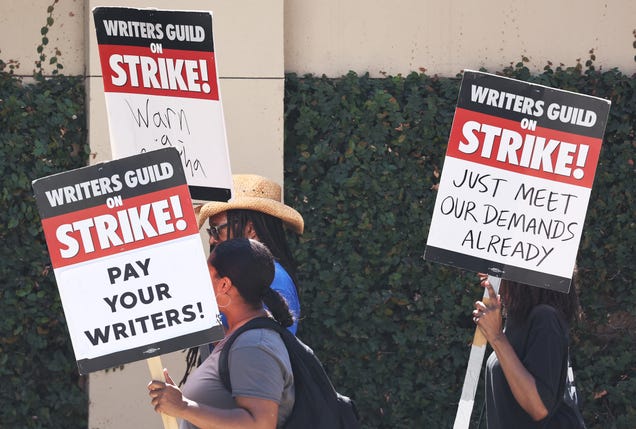
Throughout the Hollywood strikes happening this summer, the WGA has been frank in giving updates on its attempted negotiations with studios and the AMPTP. Said talks haven’t really gone well on account of the AMPTP reportedly not operating in good faith or only wanting to meet some (but not all) of the WGA’s demands.…
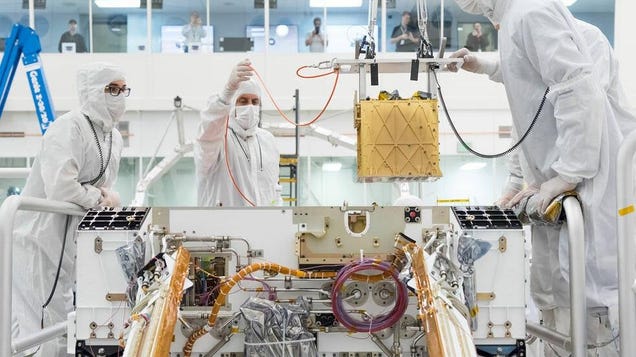
On April 20, 2021, the spiritedly-named MOXIE experiment on Mars extracted 5 grams of oxygen from the Martian atmosphere, demonstrating a potential future capability of an established human presence on the Red Planet—and in other atmospheres besides Earth’s, for that matter.
In the future, when you need someone's help to get a task done, you might find yourself launching the Uber app on your phone. According to Bloomberg, the company is exploring the possibility of offering a new TaskRabbit-like service. Developer Steve Moser found code hidden within Uber's iPhone app for an offering that's reportedly codenamed "Chore." Based on its current iteration, Chore will let you hire "taskers" and will let you specify in the app what you need help with, how long you think it would take and what time you want the tasker to arrive.
Of course, you'll be able to input the address of where you want the person to go before you submit your request. Uber will then compute a payment that's commensurate with the time required to finish the task, but you will have to pay for a minimum of one hour no matter what it is. Bloomberg says the code Moser unearthed didn't have hints on what types of help you can ask from providers, but the potential service's rival TaskRabbit has a wide range of categories to choose from. These include cleaning, furniture assembly, electrical help, plumbing, TV mounting, packing and moving, snow removal, computer assistance, pet sitting and even senior care.
Like any other unconfirmed feature still in development, though, Chore may not even make it to public release. If it does, it'll be a huge new undertaking for Uber, which is known for its ride-hailing and restaurant delivery services. Over the past months, Uber rolled out Carshare, which lets users borrow cars from private owner, to more locations as part of its efforts to become a zero-emission platform by 2040. It also started testing a toll-free number — 1-833-USE-UBER (1-833-873-8237) — that you can call to schedule an immediate or a future ride.
This article originally appeared on Engadget at https://ift.tt/zbOT96o
from Engadget is a web magazine with obsessive daily coverage of everything new in gadgets and consumer electronics https://ift.tt/zbOT96o
via IFTTT https://ift.tt/7XoRiBw
This isn’t your parent’s Lotus. The British maker, once famous for ultra-lightweight sportscars that had no room for creature comforts like air conditioning, heated seats, or even doors, is now part of the Geely family, with designs on a big international presence with big sales.
That’s going to require bigger cars, and while the Eletre SUV was something of a first big departure for the company, the Emeya is a quick second-act. The Emeya is a four-door sedan with a swoopy, coupe-like profile, comfortably seating four and, Lotus says, offering somewhere around 300 miles of range from a 102kWh battery pack.
That’s quite good range for a car that will offer up to 905 horsepower and that can sprint from 0 - 60 mph in less than 2.8 seconds. Quick, yes, but as a grand tourer, the idea is comfort and luxury, and that the Emeya has in spades. But will it be good enough to convert the Lotus faithful? That we won’t know until sometime in 2024, when this enters production. Watch the video below for the full story.
This article originally appeared on Engadget at https://ift.tt/IPSNBek
from Engadget is a web magazine with obsessive daily coverage of everything new in gadgets and consumer electronics https://ift.tt/IPSNBek
via IFTTT https://ift.tt/7XoRiBw
Apple has released a critical iOS 16 security update for iPhones and iPads to patch a particularly malicious bug that could allow a hacker to take over your device with no action on your part. The "zero-click, zero-day" exploit allows attackers to install NSO Group's Pegasus spyware, which could let them read a target's text messages, listen in on calls, pilfer and transmit images, track their location and more.
The exploit (referred to as "Blastpass") was first discovered by Citizen Lab, which immediately disclosed it to Apple. It was reportedly used to install Pegasus onto the iPhone of an employee from a Washington DC-based organization. It's capable of compromising devices running the latest 16.6 version of iOS "without any interaction from the victim," the group wrote.
Apple has released iOS 16.6.1 to counter the vulnerability, stating simply that "a maliciously crafted attachment may result in arbitrary code execution." In addition, Citizen Lab even advised "all at-risk users to consider enabling Lockdown Mode as we believe it blocks the attack." It's believed that the attack involved PassKit (an SDK that allows developers to put Apple Pay in their apps), hence the Blastpass name, along with malicious images sent by iMessage. For obvious reasons, Citizen Lab didn't release any other details.
Lockdown mode is a recent iOS feature designed to severely restrict the functions of Apple devices and is aimed at a "very small number of users who face grave, targeted threats to their digital security," Apple has stated. The company has faced a number of threats of late, including a vulnerability from February 2023 that "may have been actively exploited," Apple said at the time.
The exploit also brings Pegasus back into the news, following a ban by the Biden administration earlier this year. Developed by the Israel-based cyber-arms company NSO Group, it created a furor after it was used by multiple nations to spy on journalists, activists and others. In one notorious case, it was reportedly used by Saudi Arabia to spy on journalist Jamal Kashoggi, who was later murdered in Turkey.
This article originally appeared on Engadget at https://ift.tt/ycEUGqe
from Engadget is a web magazine with obsessive daily coverage of everything new in gadgets and consumer electronics https://ift.tt/ycEUGqe
via IFTTT https://ift.tt/oPuSwFW
Following Huawei's surprise launch of the seemingly 5G-capable Mate 60 and Mate 60 Pro smartphones last week, the Chinese firm has today unveiled two more devices: the Mate 60 Pro+ and the Mate X5 foldable. Huawei was largely limited to 4G connectivity on its handsets since the US sanctions, but with this latest wave of smartphone launches, the company has been intentionally secretive about its choice of radio. Sources told Engadget that these are indeed 5G devices — as supported by Chinese blogger Vincent Zhong's speed test on the new foldable, which reached a download speed of over 1Gbps (you'll see that there is no 5G indicator on the screen).
It's likely that both phones are also powered by Huawei's mysterious HiSilicon Kirin 9000S, the 7nm process node of which has raised concerns on whether the local chip supplier, SMIC (Semiconductor Manufacturing International Corporation), has violated US sanctions to access foreign chip-making technology. Huawei did not immediately respond to requests for comments about the specs of these new phones or the chip.
A recent Kirin 9000S teardown conducted by TechInsights for Bloomberg confirmed SMIC's 7nm process, which was thought to be impossible given the import ban on key manufacturing equipment — namely the EUV lithography machines from Dutch firm ASML (Advanced Semiconductor Materials Lithography). Before the US import ban, Huawei relied on TSMC (Taiwan Semiconductor Manufacturing Company) for its 5nm process, which was enabled by ASML's machines.
It is unlikely that SMIC procured such advanced machinery from ASML — at least not directly — without raising alarms. According to Bits & Chips, ASML CEO Peter Wennink recently expressed that "the Mate 60 Pro shouldn’t come as a surprise to anyone, as the restrictions essentially forced the Chinese to double down on innovation." Thus implying that SMIC could well have developed its own high-end lithography machine.
Benchmarks conducted by Chinese tech blog Geekerwan suggest that the Kirin 9000S' performance is close to Qualcomm's Snapdragon 888, meaning it's around two generations behind. The site added that the CPU here features one big core and three middle cores based on Huawei's own "TaiShan" architecture, in addition to four little cores based on Arm's efficient Cortex-A510. As a bonus, the Kirin 9000S is the first mobile processor to support multi-threading — running eight cores with 12 threads, though apparently apps will require further optimization to make use of this feature. As for the GPU, Huawei added its own Maleoon 910, which is allegedly on par with the one in the Snapdragon 888.
Huawei Mate 60 Pro+
Huawei
Much like the Mate 60 Pro, the higher-end Mate 60 Pro+ supports satellite call service by China Telecom and satellite messaging using BeiDou. The only notable differences (that we can see for now) are the different "nanotech metallic double dye process" and better rear cameras. As for the Mate X5 foldable, it's almost identical to the super slim Mate X3, except for the switch to Huawei's fancier Kunlun Glass on the external screen (hence a 2g bump in weight), as well as the slightly tweaked appearance of the rear camera island. Huawei has yet to reveal prices for either model, though pre-orders will start at 6:08PM local time today.
If all four of Huawei's latest smartphones are indeed powered by Kirin 9000S, it would suggest that Huawei is confident with its chip yield — potentially adding a further blow to the US sanctions. Rumors suggest that we'll be hearing more about these devices towards the end of September — conveniently avoiding the iPhone 15 rush.
This article originally appeared on Engadget at https://ift.tt/fMw2PhI
from Engadget is a web magazine with obsessive daily coverage of everything new in gadgets and consumer electronics https://ift.tt/fMw2PhI
via IFTTT https://ift.tt/ivZsI6J
One of the consequences of Brexit was that the UK was forced out of several key European Union science programs, including the Galileo satnav project and Horizon, the EU's flagship science research scheme. Now, the UK is set to rejoin Horizon as an associate country under what UK Prime Minister Rishi Sunak and European Commission President Ursula von der Leyen called a "bespoke deal."
The UK will also become an associate member of Copernicus, the EU's £8 billion (€9 billion) Earth observation satellite program. It won't be rejoining the Euratom nuclear research group, however, instead choosing to focus on its own nuclear fusion research. Under the terms of the deal, the UK will contribute almost €2.6 billion (£2.2 billion or $2.75 billion) per year on average for its participation in both Horizon and Copernicus.
"We have worked with our EU partners to make sure that this is the right deal for the UK, unlocking unparalleled research opportunities, and also the right deal for British taxpayers," said Sunak. "The EU and U.K. are key strategic partners and allies, and today’s agreement proves that point. We will continue to be at the forefront of global science and research," added von der Leyen.
Scientists in the UK who feared research isolation expressed relief. "Thank you to the huge number of researchers in the U.K. and across Europe who, over many years, didn’t give up on stressing the importance of international collaboration for science," biomedical researcher Paul Nurse told the Associated Press.
The UK was kept out of Horizon due to a dispute over the Northern Ireland Brexit trading agreement, despite positive negotiations in 2020. A deal was struck for a UK return in February 2023, but negotiations stalled over the UK's level of financial commitment.
A key tenet was that the UK would not pay for the years of absence, but the UK's opposition Labour Party also noted that Britain had missed out on a lot in that time. "Two years of global companies looking around the world for where to base their research centers and choosing other countries than Britain, because we are not part of Horizon," said Labour science spokesman Peter Kyle. "This is two years of wasted opportunity for us as a country."
Horizon Europe "tackles climate change, helps to achieve the UN’s Sustainable Development Goals and boosts the EU’s competitiveness and growth," according to the European Commission. It includes all EU member states and 17 associate nations as of January 2023, and boasts a budget of €95.5 billion ($102 billion).
This article originally appeared on Engadget at https://ift.tt/iLk7KVD
from Engadget is a web magazine with obsessive daily coverage of everything new in gadgets and consumer electronics https://ift.tt/iLk7KVD
via IFTTT https://ift.tt/R1nlfAL
Pinterest is again changing its search algorithm to make its results more representative of the people using its platform. The latest update is aimed at improving the visibility of plus-size fashion and other styles that highlight a broader spectrum of body shapes and sizes.
With the changes, searches for women’s fashion and wedding looks will surface results with a more diverse range of body types, Pinterest says. Annie Ta, Pinterests’s head of inclusive products, said the changes were driven by the realization that many users were adding “descriptions and qualifiers,” to their queries in an effort to find the styles that best fit their needs. “They were experiencing something really similar: recommendations that were homogenous and not very diverse,” she said.
It’s not the first time Pinterest has taken steps toward more inclusive search features. The company, which has cultivated a reputation as a kinder social media company, added skin tone filtering to makeup and other beauty-related searches in 2018, and introduced hair pattern search in 2020.
It took a similar approach in looking at ways to tweak its algorithm to surface results that would be more inclusive for the plus-size community. Ha says the Pinterest’s algorithm has been trained on more than 5 billion images and videos on its platform to detect and categorize different body shapes and sizes. The company also tapped advocates and creators from the plus size community for advice on the changes. Now, users should be better able to browse styles without adding on extra search terms like “curvy” or “plus size.”
According to Ha, early results suggest the feature is effective. She says that the representation of different body types in search results for women’s fashion has improved by more than four times since implementing the algorithmic tweaks. Though the changes are limited to women’s fashion and wedding-related content for now, she says the company is looking to expand body type representation into other categories as well.
This article originally appeared on Engadget at https://ift.tt/wbEltjs
from Engadget is a web magazine with obsessive daily coverage of everything new in gadgets and consumer electronics https://ift.tt/wbEltjs
via IFTTT https://ift.tt/R1nlfAL
More than 50 years ago, the Apollo program was crafted as a result of rising political tensions between two competing nations. As a new group of countries and emerging space companies set their eyes on the Moon once more, they aren’t going back for national pride but rather to further their space ambitions beyond the…